

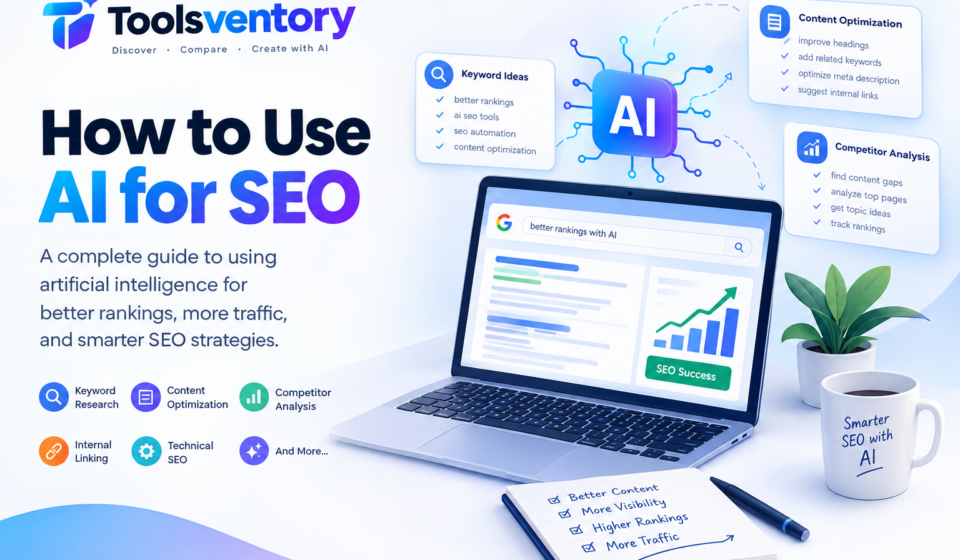

How to Use AI for SEO: A Complete Guide to Using Artificial Intelligence for Better Rankings
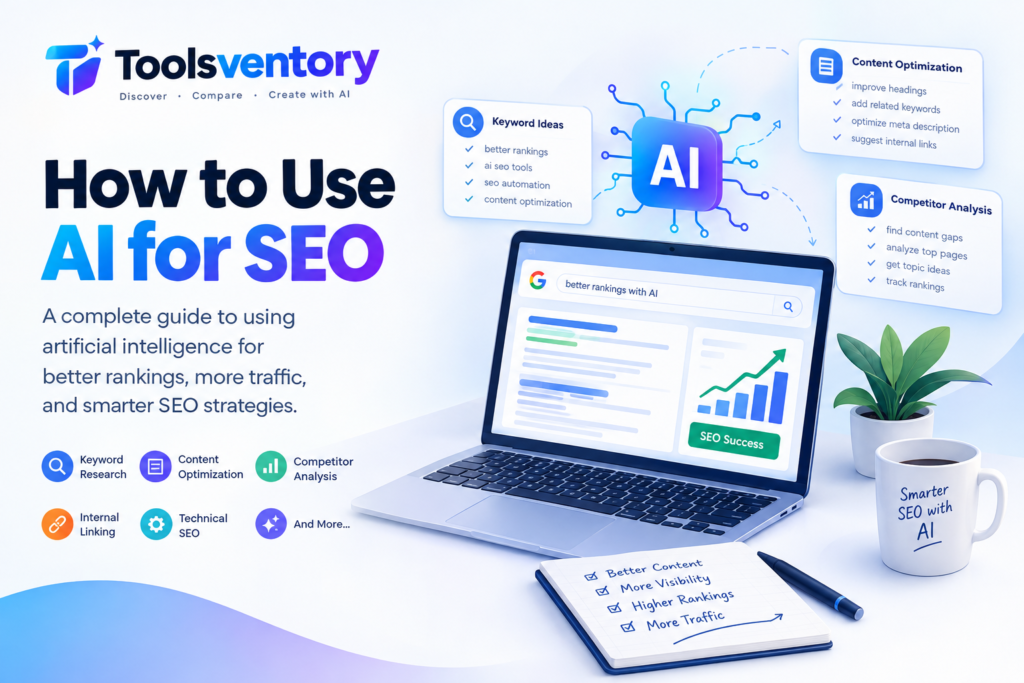
Search engine optimization (SEO) has changed dramatically over the past few years. What once required hours of manual keyword research, content planning, competitor analysis, and optimization can now be accelerated with artificial intelligence (AI).
But AI isn’t a replacement for good SEO strategy. The best results come from combining AI-powered tools with human expertise, original insights, and a strong understanding of search intent.
In this guide, you’ll learn how to use AI for SEO, which SEO tasks AI can help with, how to create better content with AI, and how to build an effective AI-powered SEO workflow.
What Is AI for SEO?
AI for SEO refers to using artificial intelligence tools to improve different parts of the search engine optimization process.
AI can help SEO professionals and website owners with tasks such as:
- Keyword research
- Search intent analysis
- Content planning
- Topic research
- Content optimization
- Competitor analysis
- Title and meta description generation
- Internal linking
- Technical SEO analysis
- Content gap analysis
- SEO reporting
- Website audits
- Content updates
Instead of manually completing every repetitive task, you can use AI to analyze information, generate ideas, identify patterns, and speed up your workflow.
The important distinction is that AI should assist your SEO strategy rather than blindly automate it.
Why Use AI for SEO?
SEO can be time-consuming. A single article may require keyword research, competitor research, outlining, writing, editing, optimization, internal linking, and performance analysis.
AI can significantly reduce the time required for many of these tasks.
1. Save Time
AI can quickly generate keyword ideas, content outlines, title variations, FAQs, and optimization suggestions.
2. Discover New Opportunities
AI can help identify related topics, long-tail keywords, content gaps, and questions your audience may be searching for.
3. Improve Content Structure
AI can analyze the structure of content and suggest headings, subtopics, questions, and sections that may make an article more comprehensive.
4. Automate Repetitive SEO Tasks
Tasks such as creating title variations, summarizing content, categorizing keywords, and analyzing large amounts of data can be accelerated with AI.
5. Scale Your SEO Strategy
Businesses and publishers can use AI to support larger content operations without manually performing every repetitive step.
How to Use AI for SEO
There are many ways to incorporate AI into an SEO workflow. Let’s look at the most useful applications step by step.
1. Use AI for Keyword Research
Keyword research is one of the foundations of SEO.
Instead of simply asking AI to generate a list of popular keywords, use it to discover different types of search queries and search intent.
For example, if your website is about AI tools, you could ask AI to identify keyword ideas around:
- AI tools for students
- Best AI writing tools
- AI tools for SEO
- Free AI tools
- AI tools for content creators
- AI productivity tools
You can then organize these keywords into groups based on search intent.
Example keyword categories
Informational:
- What is AI SEO?
- How does AI help SEO?
- How to use AI for keyword research
Commercial:
- Best AI SEO tools
- Best AI writing tools for SEO
- AI SEO software comparison
Transactional:
- Buy SEO software
- AI SEO tool pricing
- SEO automation software
Navigational:
- Ahrefs
- Semrush
- Google Search Console
The goal isn’t simply to collect hundreds of keywords. The goal is to understand what users are trying to accomplish when they search.
2. Use AI to Analyze Search Intent
Search intent is the reason behind a search query.
For example, someone searching for:
“best AI SEO tools”
is probably looking for recommendations.
Someone searching for:
“how to use AI for SEO”
is looking for educational information.
Someone searching for:
“Semrush pricing”
is likely evaluating or researching a specific product.
AI can help categorize keywords according to search intent and identify what type of content is appropriate for each query.
This can help you avoid creating the wrong type of page for a keyword.
3. Use AI to Create SEO Content Outlines
Before writing an article, create a detailed outline.
AI can help transform a primary keyword into a logical content structure.
For example, for the keyword:
How to Use AI for SEO
an outline could include:
- What is AI for SEO?
- Benefits of AI for SEO
- AI for keyword research
- AI for search intent
- AI for content creation
- AI for on-page SEO
- AI for technical SEO
- AI for internal linking
- AI for competitor analysis
- Common AI SEO mistakes
- Best AI SEO workflow
- Frequently asked questions
However, don’t simply copy an AI-generated outline.
Review the search results, understand the audience, and add sections that provide information competitors may be missing.
4. Use AI to Generate Content Ideas
Coming up with new SEO content ideas can become difficult after publishing dozens or hundreds of articles.
AI can help generate topic clusters around your main subject.
For example, if your website covers AI software, a topic cluster might look like this:
Main Topic
AI Tools
Supporting Topics
- Best AI tools
- Free AI tools
- AI tools for students
- AI tools for businesses
- AI tools for marketers
- AI tools for developers
- AI tools for content creators
Deeper Topics
- Best AI tools for keyword research
- Best AI tools for SEO
- Best AI tools for YouTube
- Best AI tools for social media
- Best AI tools for productivity
This creates a connected content ecosystem that can help users discover related information.
5. Use AI to Improve Existing Content
AI isn’t only useful for creating new articles.
One of its most valuable SEO applications is content optimization.
You can use AI to analyze an existing article and identify:
- Missing topics
- Weak explanations
- Unclear sections
- Repetitive content
- Potential internal links
- Missing FAQs
- Better title ideas
- Better heading structures
- Opportunities to improve readability
For example, instead of asking AI:
“Rewrite this article.”
Try asking:
“Analyze this article for search intent, topical coverage, clarity, missing subtopics, and opportunities to provide more useful information. Do not rewrite it yet.”
This produces a much more useful SEO analysis.
6. Use AI to Optimize Title Tags
Your title is one of the first things users see in search results.
AI can help generate multiple title variations.
For example:
Primary keyword: AI SEO Tools
Possible titles:
- 15 Best AI SEO Tools for Better Rankings
- Best AI SEO Tools to Improve Your Search Strategy
- 15 AI SEO Tools Every Marketer Should Know
- AI SEO Tools: The Ultimate Guide for Beginners
Don’t choose a title simply because AI generated it.
Make sure it accurately represents the page and gives searchers a clear reason to click.
7. Use AI to Write Better Meta Descriptions
AI can also help create concise meta description ideas.
A good meta description should clearly communicate what the page offers and encourage relevant users to click.
For example:
Discover the best ways to use AI for SEO, from keyword research and content optimization to technical SEO and competitor analysis.
Create several variations and choose the one that most accurately represents the page.
8. Use AI for Content Optimization
AI can help review important on-page SEO elements such as:
- H1
- H2 headings
- H3 headings
- Keyword placement
- Content structure
- Image alt text
- Internal links
- FAQs
- Readability
- Topical coverage
However, avoid keyword stuffing.
SEO is not about inserting the same keyword into every paragraph.
Instead, write naturally and cover the topic comprehensively.
Use related terminology where it makes sense.
For example, an article about AI SEO might naturally discuss:
- Artificial intelligence
- Search engine optimization
- Keyword research
- Search intent
- Content optimization
- Technical SEO
- SEO tools
- Organic traffic
- Search rankings
9. Use AI for Internal Linking
Internal links help users navigate your website and help search engines understand relationships between pages.
AI can help identify potential internal linking opportunities.
For example, if you have articles about:
- AI SEO tools
- Best AI writing tools
- AI content generators
- AI keyword research tools
- AI tools for marketers
these pages can potentially be connected through relevant internal links.
Instead of adding links randomly, ask:
“What page would provide additional value to someone reading this section?”
That is a much better internal-linking strategy.
10. Use AI for Competitor Analysis
AI can help you analyze competing content and identify potential content gaps.
You can compare competing pages based on:
- Topics covered
- Content structure
- Questions answered
- Subtopics
- Content depth
- Unique features
- Internal linking
- User intent
The objective shouldn’t be to copy competitors.
Instead, ask:
What useful information can we provide that competitors aren’t providing clearly?
This approach can help you create content that is more useful and differentiated.
11. Use AI for Content Gap Analysis
A content gap exists when your audience has questions or needs that your website doesn’t adequately address.
AI can help organize your existing content and identify missing topics.
For example, if you have many articles about AI writing tools but nothing about:
- AI tools for academic research
- AI tools for SEO
- AI tools for presentations
- AI tools for small businesses
those could represent opportunities for new content.
Creating content around relevant gaps can help expand your topical coverage.
12. Use AI for Technical SEO
AI can also assist with technical SEO.
Depending on the tools and data available, AI can help identify or explain issues involving:
- Broken links
- Duplicate content
- Missing metadata
- Redirect problems
- Indexing issues
- Structured data
- Site architecture
- Page performance
- Crawlability
However, technical SEO often requires access to actual website data.
AI should be used as an assistant for interpreting problems and suggesting solutions rather than assuming it can diagnose everything without data.
13. Use AI to Generate FAQ Ideas
Frequently asked questions can help you address related user needs.
For example, an article about AI SEO might include questions such as:
- Can AI improve SEO?
- Is AI-generated content good for SEO?
- Can AI replace SEO professionals?
- What are the best AI SEO tools?
- How can AI help with keyword research?
- How do you use ChatGPT for SEO?
The questions should be genuinely useful to your readers rather than added simply to increase keyword coverage.
14. Use AI to Create SEO Reports
AI can also help summarize SEO performance data.
For example, you can use AI to analyze information such as:
- Organic traffic
- Search impressions
- Click-through rate
- Keyword rankings
- Top-performing pages
- Declining pages
- Conversion data
Instead of spending hours reading spreadsheets, AI can help identify patterns and summarize the most important changes.
Always verify the underlying data before making important SEO decisions.
Best AI SEO Workflow
A simple AI-powered SEO workflow can look like this:
Step 1: Choose a Topic
Identify a topic relevant to your audience.
Step 2: Research Keywords
Find the primary keyword and related search queries.
Step 3: Analyze Search Intent
Determine what users actually want from the search.
Step 4: Build an Outline
Create a comprehensive structure that addresses the topic.
Step 5: Research
Gather reliable information, examples, statistics, and firsthand insights.
Step 6: Create the First Draft
Use AI to accelerate the writing process if appropriate.
Step 7: Add Human Expertise
Review, fact-check, edit, and add original examples, opinions, experiences, or data.
Step 8: Optimize the Page
Improve titles, headings, internal links, images, metadata, and overall structure.
Step 9: Publish
Publish the article and make sure the technical SEO basics are handled.
Step 10: Monitor Performance
Track rankings, impressions, clicks, traffic, and conversions.
Step 11: Update
Improve the content when new information or better insights become available.
How to Use ChatGPT for SEO
AI assistants such as ChatGPT can be useful throughout the SEO process.
For example, you can use prompts like:
Keyword Research Prompt
“Generate keyword ideas related to [topic]. Group them by search intent and identify informational, commercial, and transactional queries.”
Content Outline Prompt
“Create a comprehensive SEO content outline for the keyword ‘[keyword]’. Include the major questions a searcher would expect the article to answer.”
Content Audit Prompt
“Analyze this article for missing subtopics, unclear explanations, repetitive sections, search intent alignment, and opportunities to make it more useful.”
Internal Linking Prompt
“Based on these existing articles, identify natural internal linking opportunities for this new article.”
Content Improvement Prompt
“Review this section for clarity and usefulness. Suggest improvements while preserving the original meaning and avoiding unnecessary keyword repetition.”
The quality of the output depends heavily on the quality of the information and instructions you provide.
Common AI SEO Mistakes to Avoid
AI can make SEO faster, but using it incorrectly can hurt the quality of your website.
1. Publishing Unedited AI Content
Never assume AI-generated content is automatically ready to publish.
Review it for:
- Accuracy
- Originality
- Relevance
- Clarity
- Factual errors
- Repetition
- Missing context
2. Keyword Stuffing
Adding the same keyword repeatedly doesn’t make an article more optimized.
Write for people first.
3. Publishing Generic Content
If an AI tool can generate the same article for thousands of websites, your content needs additional value.
Add:
- Original examples
- Expert insights
- Firsthand experience
- Unique data
- Screenshots
- Comparisons
- Case studies
- Practical recommendations
4. Ignoring Search Intent
A beautifully written article can still perform poorly if it doesn’t satisfy what searchers actually want.
5. Trusting AI Without Fact-Checking
AI can produce incorrect or outdated information.
Verify important claims before publishing.
6. Automating Everything
Automation is useful for repetitive work, but SEO still benefits from human judgment.
Can AI-Generated Content Rank on Google?
AI-generated content can potentially appear in search results, but simply generating content with AI doesn’t guarantee rankings.
Search engines ultimately care about whether a page provides useful information that satisfies users.
The strongest approach is to use AI as a productivity tool while maintaining human oversight.
Instead of asking:
“How can I publish 100 AI articles?”
ask:
“How can AI help me create 10 genuinely excellent resources?”
Quality, usefulness, originality, and relevance should remain the priority.
Best AI SEO Tools
There are many AI-powered tools that can assist with SEO.
Some categories worth exploring include:
AI Writing & Content
- ChatGPT
- Claude
- Gemini
- Jasper
SEO Research
- Semrush
- Ahrefs
- Moz
Content Optimization
- Surfer
- Frase
- Clearscope
Technical SEO
- Screaming Frog
- Sitebulb
- Google Search Console
The best tool depends on your workflow, budget, website size, and specific SEO goals.
For more AI software recommendations, explore the Toolsventory AI Tools Directory.
AI SEO vs Traditional SEO
AI doesn’t necessarily replace traditional SEO.
Instead, the two approaches can work together.
| Traditional SEO | AI-Assisted SEO |
|---|---|
| Manual keyword research | AI-assisted keyword discovery |
| Manual content planning | AI-assisted topic clustering |
| Manual content analysis | AI-assisted content audits |
| Manual competitor research | AI-assisted competitor analysis |
| Manual reporting | AI-assisted reporting |
| Manual optimization | AI-assisted optimization |
| Human strategy | Human + AI workflow |
The biggest advantage of AI is speed and scale.
The biggest advantage of humans is judgment, creativity, experience, and originality.
Combining both can create a more effective SEO workflow.
The Future of AI and SEO
AI is changing how people search, how content is created, and how businesses approach digital marketing.
SEO professionals will increasingly need to think beyond traditional keyword rankings.
The future of search optimization will involve:
- Understanding user intent
- Creating genuinely useful content
- Building topical authority
- Improving user experience
- Using structured data effectively
- Monitoring new search experiences
- Creating original information
- Using AI responsibly
AI will likely become a standard part of the SEO toolkit, but human strategy will remain important.
Final Thoughts
AI can make SEO faster, more efficient, and more scalable.
You can use AI to research keywords, analyze search intent, generate content ideas, build outlines, optimize existing articles, identify internal links, analyze competitors, and interpret SEO data.
But the goal shouldn’t be to automate content production as much as possible.
The goal should be to use AI to spend less time on repetitive tasks and more time creating valuable content and better experiences for your audience.
For websites like Toolsventory, this creates an exciting opportunity. AI can help you research and organize information about thousands of AI tools while your editorial process adds the human expertise that makes the information genuinely useful.
Use AI for speed. Use human expertise for quality. Use SEO to connect the two with the right audience.
Frequently Asked Questions
Is AI good for SEO?
Yes. AI can assist with many SEO tasks, including keyword research, content planning, optimization, competitor analysis, internal linking, and SEO reporting. However, AI should support a broader SEO strategy rather than replace human judgment.
Can I use ChatGPT for SEO?
Yes. ChatGPT can help with keyword brainstorming, search intent analysis, content outlines, content audits, title ideas, FAQs, internal linking suggestions, and many other SEO tasks.
Does AI-generated content hurt SEO?
AI-generated content isn’t automatically harmful simply because AI was used. The important consideration is whether the resulting content is useful, accurate, relevant, original, and created to satisfy users rather than simply manipulate search rankings.
Can AI replace SEO professionals?
AI can automate and accelerate many SEO tasks, but it doesn’t completely replace SEO professionals. Human strategy, critical thinking, research, creativity, business knowledge, and editorial judgment remain valuable.
What is the best AI tool for SEO?
There isn’t one best AI SEO tool for everyone. The right choice depends on your goals. Some tools specialize in keyword research, others in content optimization, technical SEO, writing, competitor research, or reporting.
How can beginners use AI for SEO?
Beginners can start with simple tasks such as generating keyword ideas, analyzing search intent, creating content outlines, improving existing content, and identifying internal linking opportunities. Always review AI output before publishing it.
SEO Metadata
Primary Keyword:
How to Use AI for SEO
Secondary Keywords:
AI for SEO, AI SEO, AI SEO tools, how to use AI for SEO, AI SEO tools for beginners, AI content optimization, AI keyword research, SEO automation, artificial intelligence for SEO
SEO Title:
How to Use AI for SEO: Complete Guide for 2026
Meta Description:
Learn how to use AI for SEO, including keyword research, content optimization, search intent, competitor analysis, internal linking, and SEO automation.
Suggested URL Slug:/how-to-use-ai-for-seo/
Suggested H1:
How to Use AI for SEO: A Complete Guide
Content Category:
SEO / AI Marketing
Suggested Tags:
AI SEO, SEO Tools, Artificial Intelligence, Content Marketing, Keyword Research, SEO Automation, AI Tools
Search Intent:
Informational
Recommended Internal Links:
- Best AI SEO Tools
- Best AI Writing Tools
- Best AI Tools for Marketers
- Best Free AI Tools
- AI Tools Directory
- ChatGPT Review
- AI Content Generation Tools